
BUILD & EXPLORE
Magnetic Tile Area and Perimeter: Six Squares, Two Rectangles
Use six square magnetic tiles to compare area and perimeter. Arrange a row and a rectangle, count their outside edges, and try a partner challenge.
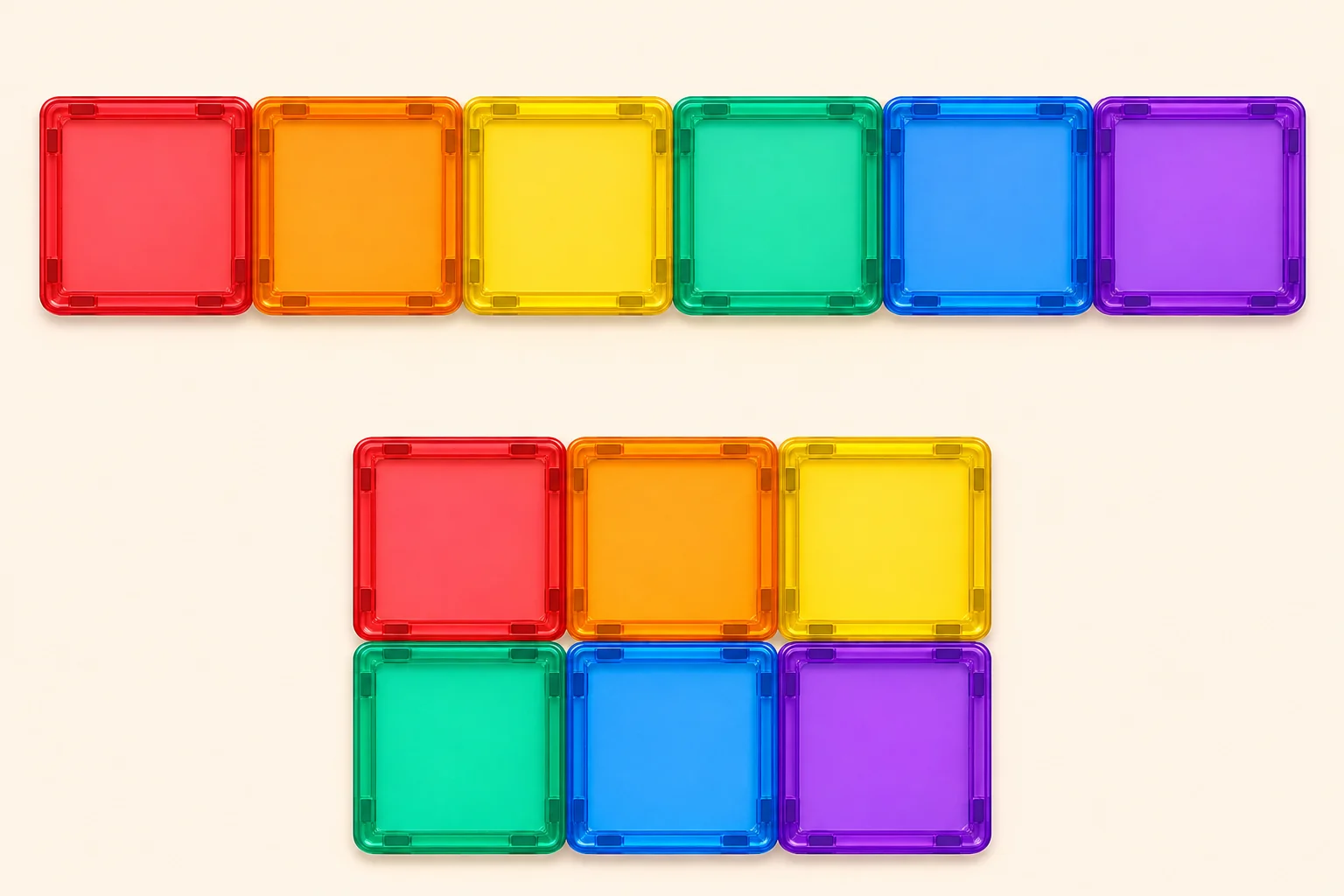
Six square tiles can make a long row or a compact rectangle. Both arrangements use the same pieces, yet the distance around their outside edges is different. Keep the tiles flat, count the squares first, then follow the boundary. This activity compares area and perimeter without needing a tall build or extra accessories.
Choose six squares and agree on your units
Gather six square tiles of the same size, a pencil and paper for recording the results. Squared paper is useful if your pieces have rounded corners or need gaps between them. Use colors you already have; matching the illustration is unnecessary. The picture shows two alternatives, but you can make them one after the other with the same six pieces.
Use tiles appropriate for the child's age and follow the instructions and warnings supplied with the set. An adult can help arrange the pieces and count each outside segment. If that is too much for the current session, start by counting the six squares and describing the long and compact shapes. Do not use the activity below the set's labeled minimum age.
For the counting below, imagine each tile as one complete square on a grid: one side is one unit long, and one whole square covers one square unit. Count the full square footprint, including its frame, rather than just the colored window. The results describe this ideal edge-to-edge model, not precise ruler measurements of rounded toy pieces. If your tiles need gaps, draw the same arrangement using adjoining squares on squared paper and count that drawing.
Make one row of six
Lay all six tiles flat in one straight row, with their neighboring edges aligned. Keep them on a clear, level surface and avoid overlapping them. If they do not sit comfortably together, leave them loose and use the squared-paper model for the counting.
Area tells you how much surface the model covers. Count the square cells once each: the row has an area of six square units. Perimeter is the distance around its outside boundary, so the next count follows edges instead of counting tiles.
- Choose the upper-left corner of the model as your starting point. Move along the top of the row, counting one unit for the top edge of each square: six.
- Turn the corner and follow the short right-hand end: one more unit.
- Follow the bottom of the row back toward the left: another six units. Finish by counting the short left-hand end: one.
- Write the two results separately: area, 6 square units; perimeter, 6 + 1 + 6 + 1 = 14 units. Do not count the joins inside the row.
Rearrange into two rows of three
Take the same six pieces and make a rectangle with three squares across and two squares from top to bottom. Align the two rows so each square has a full matching edge beside its neighbor. Keep every piece flat.
The area is still six square units because the model still contains six equal squares without overlap. Before counting the boundary, predict whether it will be longer, shorter or the same as the row's boundary.
- Starting at the upper-left corner again, follow the top edge across three squares: three units.
- Go down the right side past two squares: two units.
- Follow the bottom edge across three squares: three units. Go up the left side past two squares: two units.
- Record area, 6 square units; perimeter, 3 + 2 + 3 + 2 = 10 units. Compare this with the first row's 14-unit perimeter.
Compare what stayed the same and what changed
Your record should show two different measurements for each arrangement. One row of six: area 6 square units, perimeter 14 units. Two rows of three: area 6 square units, perimeter 10 units.
No squares were added or taken away, so the area stayed the same. In the compact rectangle, more tile edges meet inside the shape. Those shared edges are not part of the outside boundary. The perimeter is four units shorter even though both arrangements cover six square units.
Turn the compact layout so it has two squares across and three from top to bottom. Predict and check again: its area remains six square units and its perimeter remains ten units. A turn changes the direction of the rectangle, not the number of squares or the total length around it.
Fix the most common counting mix-ups
If you count six for both measurements, check what you are pointing to. For area, point to each whole square. For perimeter, follow each square-length segment on the outside. One corner tile can contribute more than one outside segment.
If you count 24 edges, you have counted all four sides of each of the six squares separately. Some of those sides meet inside the arrangement. Trace only the outside boundary, without cutting through an internal join.
Do not count corners as extra units or include a small gap as another square. Use adjoining cells on squared paper when physical frames or gaps make the boundary hard to follow. Keep the units named: square units for area and units of length for perimeter. A square unit is not the same kind of measurement as a unit of length.
Try it with a partner or a small group
Give each pair six suitable square tiles and a sheet of paper. Four pairs need 24 equal-size squares in total. Count the actual shapes available rather than assuming a set's total piece count means every piece is a square. Pairs can take turns at one station when supplies are limited.
One person arranges the tiles and the other records the two counts. Ask the checker to trace the entire boundary once, returning to the starting corner. Then swap roles and rearrange the same six pieces.
Use a simple prompt: What stayed at six, and why did the outside count change? Accept a pointing or tracing explanation before asking for written calculations. This is an original suggested activity, not a classroom-tested lesson or a promise of a particular learning outcome.
Choose another flat-tile challenge
Keep the two sketches and their measurements if you want to repeat the comparison later. When you finish, separate and store the pieces according to your set's instructions. The illustration is AI-generated and shows alternative layouts, not actual product photography or verified box contents; this activity has not been physically tested.
For another way to compare positions, choose All build ideas and open Magnetic Tile Symmetry Activity. For a themed picture, try the flat twelve-piece castle guide. Both activities keep the arrangement on the play surface.
Use Explore the set to view the MKGCRAFTED 120-piece set. For group supplies, the Classroom & bulk orders link leads to the inquiry page. Plan the required square shapes before choosing supplies for several pairs.
One small idea can lead to the next.
Find another build idea