
BUILD & EXPLORE
Magnetic Tile Repeating Patterns: AB, AAB and ABB
Use eight square magnetic tiles to copy, extend and fix AB, AAB and ABB color patterns. Includes exact piece counts and a simple partner activity.
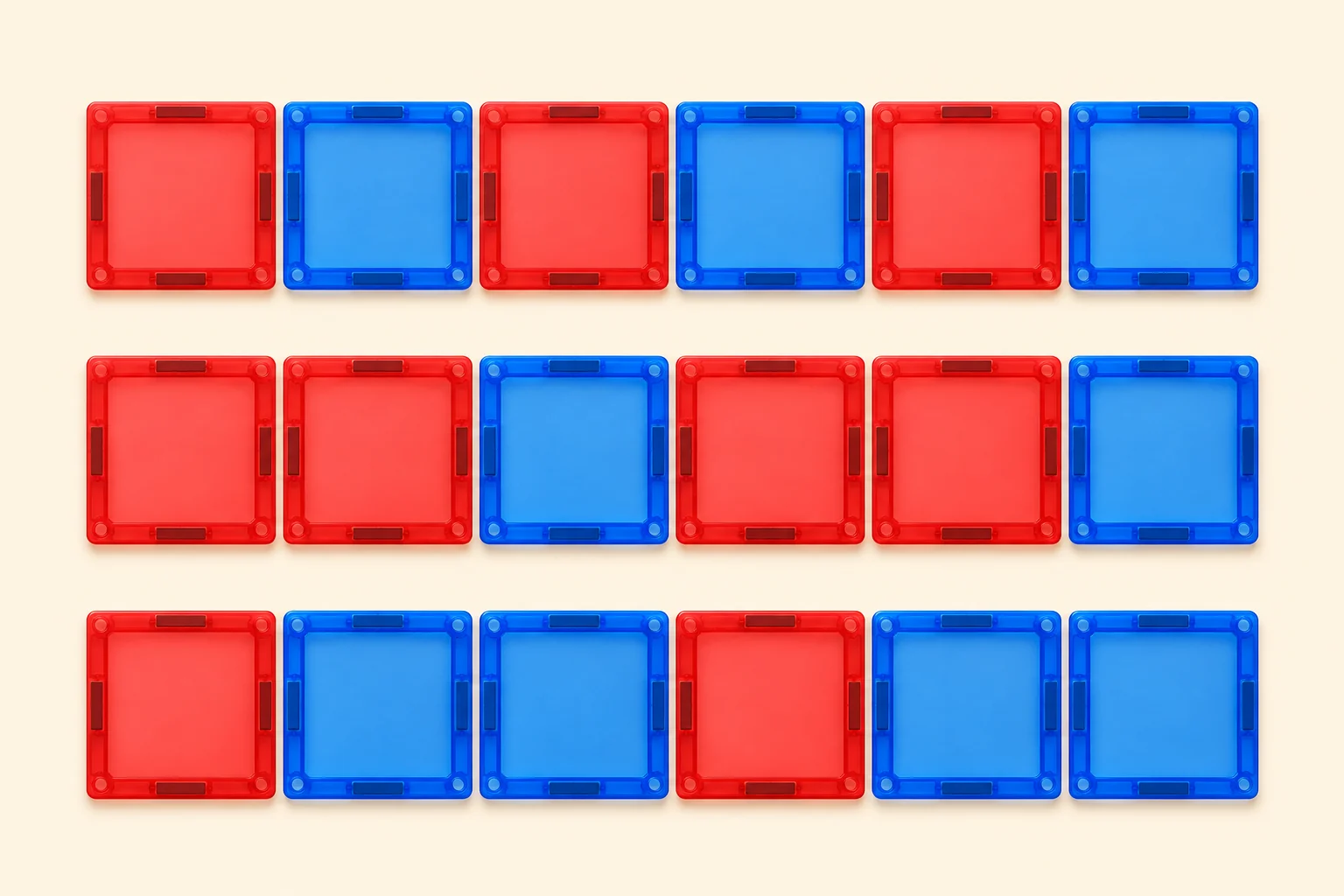
A row of magnetic tiles can be a pattern to read, not just a wall to build. Choose two colors, find the small unit that repeats, and use that rule to decide what comes next. These flat activities use one eight-tile kit, rearranged for each example; you do not need to build all three rows at once.
Gather four squares of each color
Choose eight equal-size square tiles: four in one color and four in a second color. In the examples, A means red and B means blue. You can choose other colors, but keep the meaning of A and B fixed throughout each round. Check the pieces you actually have; a mixed set's total piece count does not guarantee this color assortment.
Ages 5-7 are a suggested starting range for these copy-and-explain activities. Adjust the help to the child and follow the set's labeled minimum age and instructions. Begin with copying a short row before asking the child to invent or correct one.
Keep all tiles flat on a level surface, with a small gap if the frames make the color order easier to see. Magnetic connections are optional. If the colors are hard to distinguish or you do not have the required assortment, use eight equal paper squares marked with two clearly different symbols instead.
Pick a starting end and find the repeat
Read each example from left to right, starting at the same end every time. Sit side by side when comparing rows so that both people use the same starting point.
A repeating unit is the short group you copy again in the same order. For A B A B A B, the shortest repeating unit is A B. For A A B A A B, it is A A B. Point to one complete unit, then point to the next matching unit before predicting another.
The spaces in the written examples separate individual tiles. They do not mean that each tile is a whole repeating unit. Say the color names aloud while pointing if the letter labels are unfamiliar.
Build an AB pattern with six tiles
Use three A tiles and three B tiles. Leave one tile of each color beside the row as spares. The finished row has three copies of the two-tile unit A B.
- Place one A tile at the left and one B tile to its right.
- Repeat that same pair twice more: A B A B A B.
- Point to tiles one and two, then three and four, then five and six. Each pair should have the same color order.
- Ask for the next whole unit. Add the two spare tiles as A B to make A B A B A B A B, with four complete repeats.
- Take the row apart and return all eight tiles to the kit before the next pattern.
Change the rule to AAB, then ABB
These examples each use six tiles, but they need different color counts. Rebuild one row at a time from the eight-tile kit; you cannot make the illustrated three-row display simultaneously with only eight tiles.
For A A B A A B, use four A tiles and two B tiles. Point to the first three tiles as one unit, then to the next three as the second unit. The two A tiles together are part of the rule, not an error.
Take that row apart. For A B B A B B, use two A tiles and four B tiles. Again, identify two complete three-tile units. The rule now has one A followed by two Bs.
Compare the spoken units: A A B and A B B. Both have three positions, but their color order and color counts differ. Keep reading from the chosen starting end.
Predict a whole unit before reaching for more tiles
After A A B A A B, the next complete unit would be A A B. Nine tiles in total would be needed for three repeats: six A and three B. Starting from the eight-tile kit, you would need two additional A tiles; one B from the kit would remain unused.
After A B B A B B, the next complete unit would be A B B. Three repeats need three A and six B. You would need two additional B tiles beyond the kit, leaving one A unused.
If you do not have the extra colors, say or draw the next three positions instead. Do not fill the row with whichever tiles are left: spare pieces do not change the chosen rule.
Ask both questions: 'What is the next tile?' and 'What is the next whole unit?' A correct single color is only one part of a complete explanation.
Find and repair a stated pattern
Tell the child the intended rule first. A finite row alone can be continued in different ways; this round is specifically about repeating A B from the left. Treat a mismatch as something to investigate together.
- Build A B A B A B using three tiles of each color.
- Swap the third and fourth tiles. The row becomes A B B A A B.
- Read the row in pairs from the left. The first pair is A B, the middle pair is B A, and the last pair is A B.
- Ask which pair differs from the stated A B unit and how to repair it while keeping the same tiles.
- Swap the middle pair back. Read all three A B units again and explain why the row now follows the rule.
Share a pattern station
Give a pair one eight-tile kit and a sheet of paper. The builder chooses AB, AAB or ABB, says the rule and makes two or three complete units as the counts above allow. The checker points to each unit and predicts the next one, then they swap roles.
For four pairs working at once, count 32 equal square tiles: 16 of color A and 16 of color B. If that assortment is unavailable, use one shared station or the paper-square alternative. Count suitable shapes and colors before ordering supplies.
On the paper, record the chosen unit, the finished sequence and the predicted next unit. A child can point, say the colors or draw symbols; writing the letter code is optional.
To make another round, keep the same AB rule but exchange which color represents A and which represents B. Agree on the new mapping before building. The visible colors change while the two-position repeating structure stays the same.
Choose another flat activity or plan supplies
Use All build ideas to find Magnetic Tile Symmetry Activity when you want to compare a reflection across a line with a repeating sequence along a row. The area-and-perimeter guide uses flat squares for a different counting question.
Explore the set opens the MKGCRAFTED 120-piece collection. Classroom & bulk orders opens the inquiry page for group supplies. Check the required square sizes and color counts against your collection rather than treating every piece as interchangeable.
These are suggested activities, not physically or classroom tested instructions, and no particular learning outcome is promised. The AI-generated illustration compares all three six-tile rows together; it is not actual product photography or a statement of box contents. Reuse the eight-tile kit for one row at a time.
One small idea can lead to the next.
Find another build idea